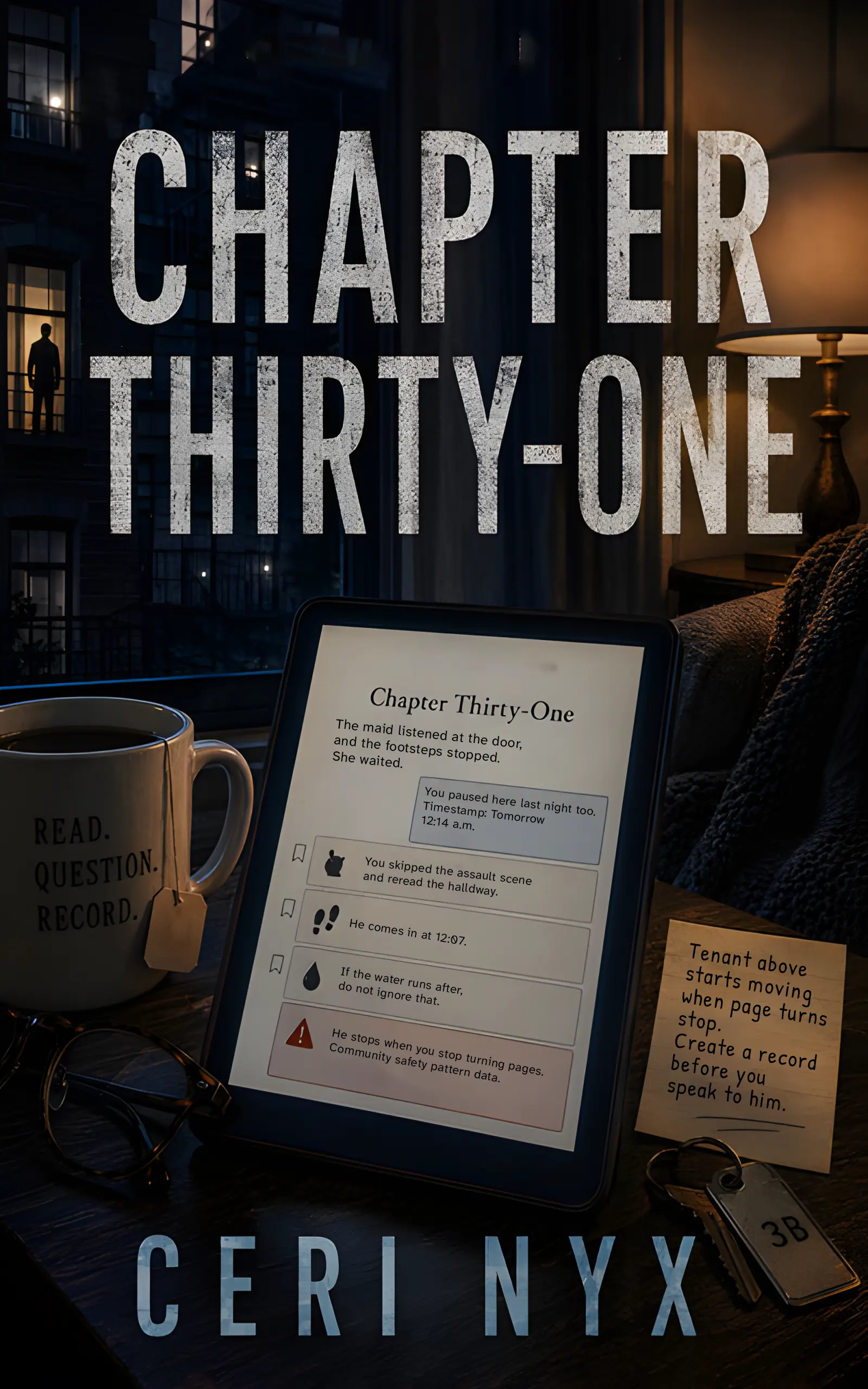

Chapter Thirty-One
There was a note on Chapter Thirty-One, and Susan Bailey didn’t put it there. She gripped the e-reader. What the… Tomorrow’s date was on it.
She lowered the device to her lap and nudged her reading glasses higher on her nose. Kate’s living room had dimmed while she’d been reading. The lamp beside the sofa lit the library tote beside the radiator. Susan’s overnight bag was already in the bedroom. But her backup supply of paperbacks just had to be within reach. She reached for her mug and took a sip of cold coffee. She grimaced. Ugh. She put it back down.
Footsteps crossed the apartment overhead. Three heavy thumps, then a pause, then the sound of water hissing through the pipes. Kate had laughed about the routine yesterday.
“That’s Todd. Every frickin night. Three laps across the living room and then he runs the faucet for no reason.”
Susan returned to the e-reader’s margin.
You paused here last night too.
The timestamp read 12:14 a.m. tomorrow. She tapped on the note, expecting a bubble to give her more information. Nothing, nada. She tapped it again because devices sometimes responded to a stern finger.
Half the page was covered with an annotation menu. She brought the e-reader closer to her eyes. Narrow light-gray lettering appeared directly under the note.
Synced from community safety pattern data.
“That isn’t a thing,” she told the room.
A chair leg bumped across the floor overhead.
Susan lowered the e-reader again. Water moved through the pipes. A delivery truck groaned somewhere on the street below. Todd was quiet though.
Kate blamed the building when Susan mentioned the noise on her first night. The pipes knocked, the walls were too thin, while the floorboards carried everything. But hey, for what they could afford it was downright luxury. They’d listened to the footsteps and knocking for another minute until Kate turned up the television.
A man’s voice rose across the hall, followed by the hard click of a door. She rolled her eyes. The couple had started again. They tried to keep their arguments down, but then one of them remembered something unforgivable, and the shouting started all over again.
Three heavy steps crossed the ceiling again. What was he doing? The faucet ran briefly. He must have very clean hands.
Living alone had trained Susan to notice sounds. Six nights in her sister’s apartment had taught her the routines of three apartments.
She picked up the e-reader and turned back a page, then forward again. A second note appeared beside the same paragraph.
You skipped the assault scene and reread the hallway.
Susan’s thumb rubbed the edge of the case. It’s private, she’d insisted to library users over the years. Your borrowing history is only for you. She’d said it multiple times across the reference desk to women who’d turned their book covers upside down and men who cleared their throats to ask if they had any addiction memoirs.
She’d genuinely believed it and they’d believed her. Several apologies might now be overdue.
She opened Settings, found Sync, and entered the Reading Layer menu. Three active switches appeared under the cheerful headings of Shared insights, Protective pattern annotation, and Continuity support.
“Continuity support,” Susan said. “What in Sam Hill is that?”
Small print appeared beneath the options.
Helpful reading insights may be provided when similar activity has been reported by other readers.
She’d turned sixty-eight in March. In e-reader world, that apparently qualified her for predictions and supervision. “Helpful” comments from strangers were a bonus. Fabulous.
Susan shook her head and started reading again. The heroine had reached the corridor outside her husband’s study. Susan had skipped the earlier assault because she had no desire to spend an evening trapped in a fictional woman’s pain. She’d reread the corridor because the heroine was following clues she had to pay attention to. She’d been counting doors and finding mud next to the baseboard. Then the maid called the delivery man charming. Now that had to mean something.
She was still irked though. The app had noticed a pattern. That didn’t make the rummaging any less objectionable. She was paying good money for this subscription. That meant privacy, didn’t it?
Susan switched off Shared Insights, but when she navigated back, the note was still in the margin.
Protective Pattern Annotation went next. When she refreshed the page, there were two new archived comments under the chapter heading.
He comes in at 12:07.
If the water runs afterward, pay attention.
The ceiling creaked. Susan tilted her head toward the ceiling. Todd was crossing his apartment. His steps halted above Kate’s bedroom. Water hissed through the pipes for four seconds.
A third note loaded.
He starts moving when you stop turning pages.
Susan rose from the sofa. Her knees cracked. They could just shut up. She crossed to Kate’s front door to test the chain. It was in its brass track and the deadbolt was locked. Susan leaned toward the peephole.
The corridor stairs to the fire door were just visible to the side under the yellow ceiling lights. A plastic fern occupied the table opposite Kate’s apartment. Someone had placed a ceramic rabbit beside its pot and tied a red bow around its neck.
Susan strode to the living room, collected her coffee, and carried it into the kitchen. She wasn’t going to be tricked by the half-full mug a second time. She emptied it, rinsed it, and filled a glass from the tap instead.
Todd’s faucet ran overhead. The pipes knocked once after it stopped.
The e-reader was glowing on the side table when Susan returned. Obnoxious machine.
She opened Account History and went through menu after menu hiding behind icons designed by someone who thought pretty was better than useful. Susan worked through each one.
Privacy gave her ad preferences, recommendation settings, and three paragraphs about how much the company valued transparency. Susan jabbed the back arrow. Not helpful.
A list of usernames filled the screen, each attached to a comment. Each reader had borrowed or downloaded the same public-domain mystery through a linked library service.
Most comments were harmless.
Good ending.
The sister annoyed me.
This edition contains twelve tyops. Needs editing.
The comments changed near Chapter Thirty-One.
Stopped here to listen upstairs.
A man is in the hall.
That final note belonged to an account marked CLOSED BY FAMILY REQUEST. That deserved a closer look.
Susan opened the reading record. The account owner borrowed three domestic thrillers in five weeks. She’d highlighted every mention of door chains, shared walls, unexpected knocks, and neighbors who’d let themselves in to fix things. Her progress ended at eighty-two percent. She stared at the screen for a moment. Privacy was an optional feature now?
Another account followed the same pattern. A third ended one page later.
One reader highlighted a sentence about wet footprints crossing a stairwell. Another moaned that public annotations needed dates and addresses if people were going to be dramatic about it.
Susan agreed wholeheartedly with that one. Drama without appropriate cataloguing served nobody.
Kate’s number flashed on the phone beside her, the message visible on the lock screen.
Still at work. Don’t stay up for me. Ignore Todd upstairs if he stomps around. He’s harmless and freshly divorced, which has apparently made him nocturnal.
Susan typed back.
Define harmless.
The typing indicator appeared, vanished, then returned.
He complains about the plumbing and hockey. That’s about it.
The ceiling gave a dull thump overhead.
Susan read her sister’s message again. Harmless could mean “he hasn’t done anything I can prove.” Sometimes it meant “he’s unpleasant, and I’m tired.” Far too often it meant “please don’t create another problem I’ll have to manage.”
Susan wrote another message back.
Has Todd ever been in your apartment?
Kate replied within seconds.
He checked a leak last month. The super let him in while I was working. Why?
Susan’s thumb paused over the screen as her e-reader chimed. A banner appeared across Chapter Thirty-One.
Library account updated.
Future checkout prepared.
This was getting tiresome. Susan opened the account page. Her name appeared beside her Maine library card number. She hadn’t used the card for anything beyond renewals since arriving at Kate’s apartment.
A new entry had appeared beneath Current Loans.
Predicted reading interruption tomorrow
Title Chapter Thirty-One
Account outcome matched to family closure pattern
Susan read that twice, then again. Closed by family?
The title wasn’t a book. It was the actual chapter she was reading. The system had removed the chapter heading from the novel and catalogued it as its own thing.
Her mouth dried. She drank water and coughed when footsteps moved overhead. Todd’s apartment door opened.
Susan put down the glass. No. She refused to let an app predict anything about her while filing a chapter as a complete book.
Susan opened Borrowing Permissions. Cross-system predictive lending had been activated the first night she connected the e-reader to Kate’s network. One of those pale blue consent screens must have carried the permission, the digital equivalent of a man talking while sliding small print under your hand.
The ceiling creaked again. Susan returned to Kate’s message. Todd had entered the apartment last month.
Kate had also complained twice that her television lost its connection every evening. Susan remembered because Kate had threatened to throw the television over the balcony.
Susan opened the router page and found the device list. One entry had no name, only a string of letters and numbers. Its connection history began on June 18.
She searched her messages with Kate for the date. Todd had entered the apartment that afternoon to inspect the leak.
Susan opened the network page on her phone and worked through the devices list. The television, Kate’s phone, the laptop, the printer, the thermostat, then her own e-reader. Six devices she could account for. The seventh carried the same string of numbers and letters. It was still active.
Susan opened the e-reader account on her phone and checked Connected Devices. Her own e-reader appeared first. Beneath it was a second entry.
Unknown Local Companion.
She tapped it.
Authorized June 18.
Susan stared at the date. That was the afternoon Todd had entered Kate’s apartment. The information panel underneath explained what a local companion was allowed to receive. Reading session active. Reading session paused. Continuity status. Household safety alerts. Oh, for Pete’s sake. The actual pages might be private, but the machine was happily announcing when she started reading, when she stopped, and whether she was still sitting there.
She opened the activity history. The unknown device had activated every evening during the previous week. Susan compared the times against her reading history. Every one matched.
When she opened the novel, it connected. When she put the e-reader down for the night, it disconnected.
The ceiling creaked above her. Todd wasn’t listening through the floor. He was reading the apartment’s activity.
Susan took screenshots of the network page, the device history, the annotations, and the scheduled checkout.
She emailed the images to Kate, herself, and Marianne at the reference desk of her old library. Marianne would open anything carrying the subject line CATALOGUE EMERGENCY. She might mock Susan later, but she’d open it.
Susan changed the sort order to Oldest First. The screen rebuilt the list by date.
He’s outside.
Going down to check the mail.
Back soon.
Use the chain tonight.
If I stop here, tell the woman upstairs.
The last comment carried a date from fourteen months earlier. Right under it, the system listed the account closure on the following morning.
A second reader had stopped at Chapter Thirty-One nine months later. The third had stopped twelve weeks ago. Each account carried the same notice.
Similar reading activity reported at this property.
All three accounts had connected from the same location marker. This building!
Footsteps crossed the apartment overhead. Susan opened the margin tool and added her own note beneath the final warning.
A man in the apartment above 3B monitors activity through this building’s network. He entered this apartment during the tenant’s absence. Anyone reading from this address should leave, keep the account records, and tell someone what is happening. Do not confront him alone.
The app requested a category. Susan chose Environmental Concern. Close enough for whoever had designed this nonsense.
Your comment has been submitted for review.
Except, just one warning could easily be missed on its own. Susan opened the linked library catalogue and searched for gardening. Let the system explain this one. She borrowed a memoir about growing herbs, something Kate would rather put pins in her eyes than read, and pasted the warning into the first chapter. Then she searched for a hockey memoir and borrowed that too.
Then she opened the account settings, changed her password and tapped on Sign out of all devices. The account refreshed. Only one active session remained.
Her eyes flicked up. Todd’s steps entered the stairwell.
Susan emailed the newest screenshot and copied the warning into a third title, a book about home plumbing repairs.
The stairwell door opened one floor above. The e-reader began producing alerts.
Unusual annotation activity detected.
Cross-title safety review initiated.
Network correlation in progress.
Todd descended the stairs.
Susan placed the e-reader in her library tote, adding Kate’s spare keys, her wallet, and the charger as an afterthought. She held on to her phone.
A board creaked outside Kate’s door. The corridor light vanished beneath a pair of feet.
The knob turned and stopped against the deadbolt.
Susan opened the camera and began recording.
The knob moved again.
She checked the chain and unlocked the lower lock. Then she opened the door to the limit of the chain.
Todd stood in the corridor wearing jeans, a hockey shirt, and bedroom slippers. He carried a small toolbox. His hair stuck up at the back.
His eyes went to the chain, then Susan’s raised phone.
“I think Kate’s internet is acting up again.”
Susan kept the camera on his face and tapped the icon for live streaming. “Is it?”
“Your reader dropped off.”
Her thumb stopped over the screen.
Todd adjusted his grip on the toolbox.
Susan raised the phone another inch. “I never told you I was using one.”
His gaze went to the camera.
“I can see connected devices from upstairs.”
“No. You can see devices on your own network from upstairs.”
“You signed out.”
Susan’s pulse hammered. He knew she’d signed out.
“I never mentioned my reader.”
Todd’s knuckles whitened on the toolbox handle. “Kate asked me to keep an eye on things.”
“My sister is on the phone with hospital security.”
Kate was probably trying to leave the emergency department while reading Susan’s messages. She’d have to apologize for the invention later.
Todd glanced toward the stairs.
Susan raised the phone higher.
“The network record identifies a device that connected on the date you entered this apartment. It became active during every reading session this week. Copies of that record have gone to three people outside the building.”
“I fixed her connection.”
“You added something to it.”
“You don’t understand what you’re seeing.”
“I understand dates.” Susan raised her arm, keeping him in frame. “The reading app connected three closed accounts to this address. Each stopped at the same chapter. Each recorded footsteps or a man in the corridor.”
Todd’s eyes moved toward the phone again. The door across the hall opened. Mr. Alvarez from 3A appeared in a white undershirt. He carried his own phone in one hand.
“Everything all right, Susan?”
Todd turned toward him.
Susan kept the camera aimed through the gap. “Todd has come to discuss why an unknown device appeared on Kate’s network after he entered her apartment.”
Mr. Alvarez lifted his phone. “Should I call the super?”
“Call the police,” Susan said.
Todd’s face lost its neighborly concern.
“This is ridiculous.”
“That should make the investigation brief.”
The elevator opened at the far end of the corridor. Mrs. Hanley from the second floor stepped out carrying two grocery bags. She stopped when she found Todd outside Kate’s chained door and two neighbors recording him.
Todd stepped back. Mr. Alvarez hadn’t moved from near the stairwell with his phone raised, while Mrs. Hanley and her grocery bags occupied the space in front of the elevator.
Susan shut Kate’s door and locked every bolt. She added the recording to the email thread she’d already sent Kate and Marianne. Only then did her hands begin to shake. Good. They’d waited until she’d finished.
She called Kate. Her sister answered over hospital noise.
“Susan, what’s happening?”
“Todd monitored your network. He came downstairs when I disconnected his device.”
“What device?”
“I don’t know, and I’m comfortable leaving that question to people who own gloves and evidence bags.”
“Susan, are you safe?”
The chain stayed on. Mr. Alvarez was speaking loudly to a dispatcher across the hall.
“For the moment.”
“I got a message that the police are heading there. Security won’t let me leave alone.”
“Good.”
“Susan?”
“Yes?”
“You said there were other women.”
Susan studied the e-reader inside her tote.
“I found three accounts.”
Kate said nothing.
The e-reader vibrated.
Susan pulled it out.
Cross-title safety review complete. Three linked accounts preserved.
Susan opened Chapter Thirty-One. Her warning now appeared above every other comment, and under it was one new note.
Thank you.
There wasn’t any information about who sent it or when. Susan tried tapping the annotation, but the resulting screen was empty.
The police knocked.
She took a screenshot, emailed it to Marianne, and placed the e-reader inside her tote. Then she unfastened the chain, unlocked the door, and let the police in.